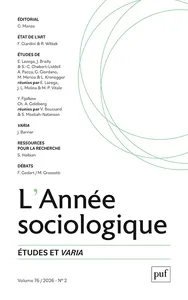
Lucas SAGE, The nonlinear nature of labor market sorting: explaining wage inequalities between and within sociodemographic groups, Sociodemographic groups with higher average wages also exhibit higher internal wage dispersion, partly explaining the overrepresentation of older, educated men in top wage percentiles. Despite being widely documented, the origins of this relationship remain poorly understood. This article proposes an explanation rooted in sorting—the tendency for workers who already command higher wages to end up in the organizations and occupations that pay the most. I argue that sorting is not merely positive but also nonlinear: its strength intensifies at higher wage levels. Because higher-wage groups experience stronger sorting, their internal wage dispersion is inflated, which contributes to the relationship between group mean wages and internal dispersion. Using French administrative data, I employ variance decompositions and simulations to quantify these effects. I find that nonlinear sorting accounts for 13% of the covariance between micro-group mean wages and internal dispersion, and for 25% of the variance in wage dispersion across groups. Simulations combined with variance function regression identify education and age as the primary dimensions along which nonlinear sorting operates. In addition, the study confirms and extends prior findings on positive sorting, showing that it accounts for 38% of between-group inequality., 2026

Alain QUEMIN, Compte rendu de Villemot (Mélio), Les artistes peuvent-ils faire autre chose que de l’art ? Enquête auprès de créateurs démissionnaires des réseaux institutionnels de l’art contemporain. Préface d’Anne Monjaret, Paris, L’Harmattan, 2025, Dans la Revue française de sociologie 2025/3-4, Vol.66, Presses de Sciences Po, 2026, 607-613
Michel DUBOIS, Catherine GUASPARE-CARTRON, (avec E.VILAIN), “The Trouble with Being “Socially Responsible”: Science, GWAS, and Sexual Orientation“, in Christopher R. Donohue, Alan C. Love (eds), Perspectives on the Human Genome Project and Genomics, Minnesota Studies in the Philosophy of Science, Volume 24, 2026

Abdelghani MADDI, Isabelle DORSCH, The Open Science Landscape Is Increasingly Difficult to Grasp. That’s a Problem, Maddi, A., Dorsch, I., & Simard, M.-A. (2026, July 21). The open science landscape is increasingly difficult to grasp. That’s a problem. Katina Magazine. https://doi.org/10.1146/katina-072126-1 , 2026
Abdelghani MADDI, Open science, open innovation? The role of open access in patenting activity, Maddi, A., Abdin, A.Y. & De Pretis, F. Open science, open innovation? The role of open access in patenting activity. Scientometrics (2026). https://doi.org/10.1007/s11192-026-05725-8, 2026
Jean-Francois MIGNOT, When girls are preferred: sex preferences in child adoption in the West, late 19th-early 21st centuries, The History of the Family, 1–19., 2026
Marta VELJKOVIC, REMILLON Delphine, "Des niveaux et souhaits de mobilité professionnelle proches selon le genre", Premiers résultats d’enquête : L’enquête Familles et employeurs (FAMEMP), Ined, 2026, 102-103
Marta VELJKOVIC, La mobilité intragénérationnelle comme moyen de (re)penser la stratification sociale, Ressources en Sciences économiques et sociales, SES-ENS, 2026
Alain QUEMIN, Art contemporain : l’impasse du modèle méga-galerie, AOC, 19 juin, 2026
Gianluca MANZO, (with Aksoy, O., Birkelund, G. E., & Raub, W.), "Standards in sociology: A position statement at the 25th anniversary of the European Academy of Sociology", Rationality and Society, 38(2), 2026, 267-280